“We Have Special Forces You Will Never See”: What Lies Behind the Army’s Moves to Secure Khartoum
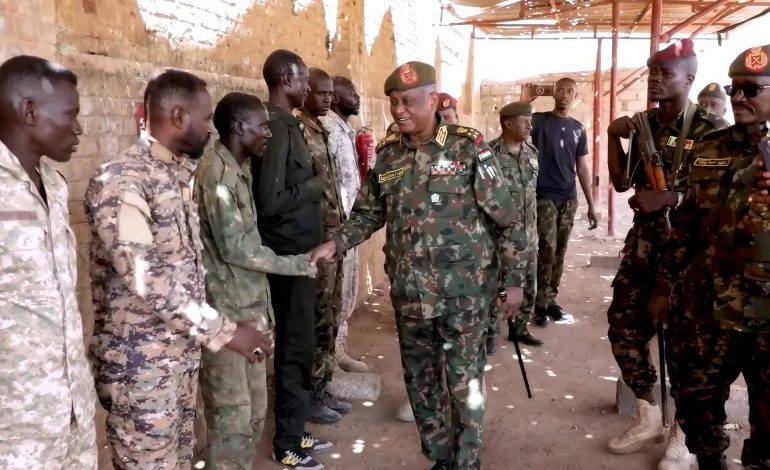
Amid escalating military operations in the Kordofan states and their approach toward the Darfur region, Sudanese Army Chief of Staff General Yasser Al-Atta announced that the training of special forces tasked with securing the capital, Khartoum, had been completed.
Speaking to a group of officers at the Wadi Seidna military base last Sunday, Al-Atta said the army had entered West Kordofan State following the liberation of South and North Kordofan, affirming that its advance into the heart of Darfur would continue in the near future.
He noted that troops were currently advancing along various combat fronts while simultaneously securing Khartoum against external and internal threats, as well as what he described as conspiracies being plotted against the country.
The previous week, Al-Atta had announced the training of special forces to secure the capital, stressing that they possessed significant deterrent capabilities. He also emphasized that the army would not allow any group or entity to impose its rule by force of arms.
“We have special forces you will never see. They have received the highest level of training, are ready at any time, and possess considerable deterrent capabilities. They have been prepared to deal with any threat that could undermine state security or compromise security in Khartoum. They are also backed by additional groups,” he said.
Observers believe Al-Atta’s statements carry a dual significance: preparation for potential security emergencies and the delivery of strategic political deterrent messages.
Securing Khartoum
During the rule of former President Omar al-Bashir, security in Khartoum did not depend on special forces. Instead, responsibility was distributed among the army’s conventional formations, security agencies, reserve forces, and Popular Support Forces, which were deployed as political and security circumstances required.
At the time, protecting the capital was integrated into the responsibilities of the army’s Central Command and the Khartoum Military Area. The National Intelligence and Security Service also had paramilitary units known as the Operations Authority, which were trained in urban warfare and internal security operations.
In addition, the Special Operations Forces were established to respond to emergencies as rapid-intervention units for specialized operations, following experiences such as the Justice and Equality Movement’s attack on Omdurman in 2008.
During the first transitional period under Prime Minister Abdalla Hamdok, however, security arrangements in Khartoum were characterized by “security laxity and institutional fragility.” This resulted from the struggle for influence between the civilian and military components of the transitional government, as well as the presence of multiple armed formations within the capital. These factors subsequently contributed to the outbreak of fighting in April 2023.
No Repeat of the Rapid Support Forces Experience
Observers warn that repeating the experience of the Rapid Support Forces (RSF)—which initially emerged as an auxiliary force before developing into a parallel military power outside the state, ultimately leading to a devastating confrontation—has become a major concern among political and military circles and the Sudanese public alike.
Against the backdrop of this experience, public and political concerns are growing over any arrangement that could lead to the emergence of armed entities operating outside the regular military establishment.
A Defense Ministry official, speaking to Al Jazeera Net, said that concerns about a repeat of the RSF experience were legitimate. However, he stressed that the battalions being reorganized and trained to secure Khartoum fall within the army’s formations and military structure, and are directly subordinate to the Chief of Staff and General Command. They do not constitute an independent militia or a force operating outside the regular military establishment.
The official, who requested anonymity, added that the military leadership understood that repeating the experience of multiple armies or establishing paramilitary formations with their own political backing could lead to the collapse of the state.
Preparing for Different Scenarios
For his part, security expert Ibrahim Abdel Qader told Al Jazeera Net that the army chief’s announcement about training a force to secure the capital cannot be separated from its political dimension. He said the announcement could be interpreted from several perspectives, including:
Preparing for different scenarios: With fighting continuing on the country’s outskirts and along relatively nearby fronts, no capital can be considered completely secure. The possibility of sleeper cells, infiltration attempts, or threats involving drones also requires the military leadership to prepare for various emergencies rather than assume that the situation is under control.
Strengthening security protection for the capital: Training special forces specifically tasked with securing Khartoum reflects an assessment that protecting the seat of power, state institutions, and diplomatic missions requires specialized formations. Their mission would not be limited to repelling attacks, but would also include tightening the security cordon and preventing any breaches or unexpected developments on the ground.
Sending messages at home and abroad: The announcement conveys the message that the army has established control on the ground in the capital and that the state is preparing to resume its functions and carry out its responsibilities from Khartoum.
Boosting morale and reinforcing political deterrence: Al-Atta’s statement comes in the context of raising the morale of the public supporting the army and sending deterrent messages to foreign powers and opposition or allied political groups. The message is that the military institution has moved beyond the stage of defense and is now focused on consolidating its position.
Reassuring Domestic and International Audiences
From another perspective, military affairs researcher Al-Amin Mohamed Al-Tayeb explains that training forces to secure Khartoum while the army is simultaneously fighting battles in Kordofan, Darfur, and Blue Nile allows the military leadership greater freedom to deploy other combat troops to active battlefronts without worrying about leaving a security vacuum in the national capital.
According to Al-Tayeb, speaking to Al Jazeera Net, announcing the readiness of the security forces is intended to reassure audiences at home and abroad that the capital has become fortified. This is a fundamental prerequisite for any future political or administrative process aimed at governing the country from within its borders.
The training of specialized and elite formations, the expert added, also reflects the military leadership’s awareness of the nature of street and urban warfare, which requires armored forces specially equipped for internal security operations and the protection of rear lines.
Concerns and Challenges
Experts and observers fear that the current alliance between the army, armed movements’ forces, and Popular Resistance groups could eventually produce entities with competing loyalties within the capital.
Furthermore, reliance on security-based solutions and the formation of armed units inside major cities could complicate any future transition to a democratic civilian state in which the armed forces are subordinate to civilian political authority.
Nevertheless, according to experts, the real test will ultimately depend on the extent to which the state commits to integrating all these formations under the umbrella of a single professional and disciplined army, while preventing any armed entity from developing an independent political or economic power base.
Source: Al Jazeera Net