Growing Opposition in American Circles to the Nomination of Emirati Candidate Lana Nusseibeh
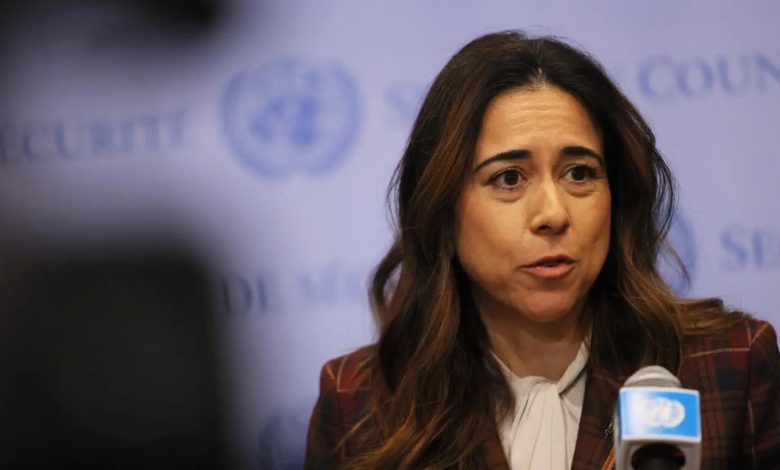
Some may assume that Sudanese people—and specifically those who support the Sudanese Armed Forces—are the only ones who regard the nomination of Emirati candidate Lana Nusseibeh for the position of United Nations Secretary-General as an insult to the victims of the conflict in Darfur and Sudan as a whole, and as a disregard for the spirit of human rights and the fundamental principles and laws of the international organization. The reality, however, is quite different.
While articles and opinion pieces rejecting and condemning this nomination continue to appear inside Sudan, similar criticism, and even more forceful opposition, is emerging abroad. Last month, for example, an American organization known for its strong advocacy of women’s rights, both in the United States and internationally, and for its opposition to American support for any state or government that engages in violence and violates human rights, issued a strongly worded statement against Lana Nusseibeh.
The organization, the Center for International Policy (CIP), which has no connection to Sudan, issued a statement on 22 October 2026 entitled “Center for International Policy Statement on the Selection of the Next UN Secretary-General: Opposition to Nusseibeh’s Candidacy.” The statement was signed by Nancy Okail, the Center’s President and Chief Executive Officer.
The Center began by noting that the Trump administration’s reported rejection of all candidates for the position of UN Secretary-General represented an unprecedented attack on international institutions and norms.
The statement emphasized that, despite the shortcomings of the international system established after the Second World War—which aspires to promote multilateralism and the rule of law—it remains far better than the global order that the Trump administration appears to be seeking to impose. Under such an order, the law of force would prevail, autocrats and oligarchs would make the rules, and corruption would be regarded merely as a “cost of doing business.” The Center stressed that the United Nations must not be used to advance this dangerous vision.
In this context, the respected organization expressed grave concern over the United Arab Emirates’ nomination of Minister Lana Nusseibeh for the position. It pointed out that the failure to reach agreement on a particular candidate did not necessarily justify turning to this specific individual as a “consensus candidate” to break the deadlock.
The Center stated that Nusseibeh, in her capacity as the UAE’s most senior diplomat at the United Nations, had served as the public face of her country’s denials that it had supplied weapons, logistical support, or diplomatic and media assistance to the Rapid Support Forces (RSF), which are implicated in killings in Sudan. She continued to maintain these denials despite mounting evidence of atrocities committed by the militia, atrocities that the United States has classified as genocide.
The Center stressed that Nusseibeh’s professional career and her family’s standing in the UAE were closely tied to an anti-democratic regime and rulers with a record of helping undermine international law. It therefore concluded that she was “an entirely inappropriate choice to lead the United Nations.”
The Center added that people around the world were watching with deep concern as authoritarian tendencies, extremism, oligarchic dominance, and rapid technological transformations reshaped their lives.
It continued: “While the time has come for a woman to serve as Secretary-General, the United Nations needs a chief official who stands with ordinary people caught in the midst of conflicts, disasters, and instability—not someone who has helped protect the wealthy and powerful individuals who fuel this violence and suffering,” as is the case in Sudan.
Another Similar Article
Three weeks earlier, an American writer of Sudanese origin living in Boston had published a forceful article in Envoy, an American magazine specializing in United Nations affairs and performance. He argued that Nusseibeh lacked the moral qualifications required to stand for the position.
Mohamed Suleiman examined the personal role Nusseibeh had played in defending Abu Dhabi against accusations of arming the rebel Rapid Support Forces, as well as her efforts to influence European lawmakers over their positions on the war. He also questioned the appropriateness of her candidacy for the position of UN Secretary-General.
He argued that her nomination raised serious concerns that made its rejection a moral imperative. Amid the ongoing war in Sudan, he wrote, evidence was mounting that the United Arab Emirates had supported the Rapid Support Forces, a militia responsible for mass atrocities against the Sudanese people.
He added that the evidence also pointed to Nusseibeh’s personal involvement in covering up the UAE’s role in the Sudanese war, demonstrating that she could not be trusted to lead the United Nations, an organization that is supposed to serve as a forum for countries seeking to promote peace and stability.
The writer also reminded the international community that Nusseibeh’s nomination, announced in New York on 21 October, coincided with a painful anniversary thousands of miles away.
Approximately a year earlier, the Rapid Support Forces had seized the city of El Fasher following an 18-month siege, committing mass killings, rape, and other atrocities against civilians. UN investigators subsequently concluded that the attack bore “the hallmarks of genocide.” There could be no greater betrayal of those victims than allowing someone who had helped enable this genocide to lead an organization entrusted with protecting them.
The Rapid Support Forces have also been implicated in arbitrary arrests and drone attacks targeting hospitals and journalists. In addition, reports indicate that the forces have recruited and used children in their military operations.
The writer pointed out that the United Arab Emirates had for years provided financial and military support to the Rapid Support Forces, including, more recently, supplying them with foreign fighters. He attributed this support to the UAE’s substantial economic and political interests in Sudan, which it seeks to protect should its allies in the RSF succeed in taking control of the country.
These interests include exploiting gold and agricultural resources, gaining control of strategic ports on the Red Sea, and preventing Islamist groups—traditionally opposed by the UAE politically—from returning to power.
The writer stated that UAE funding of the Rapid Support Forces had had catastrophic consequences. In Darfur, for example, UN experts estimated that the militia had killed 15,000 members of the Masalit tribe in ethnically motivated violence. In other parts of Darfur, women had been raped and abducted, while children had been rounded up and executed by firing squad. For many months, the city of El Fasher, the main refugee hub in Darfur, had remained under siege by the militia.
He wrote: “The UAE’s continued military support and provision of weapons to the Rapid Support Forces constitute a flagrant violation of the United Nations arms embargo imposed on the Darfur region. This reckless intervention demonstrates that the UAE has no respect for the international organization or its role, and raises questions about whether it would exploit its leadership position within the United Nations to advance its own agenda.”
The writer explained that Nusseibeh herself had played a direct role in defending the UAE against allegations concerning Sudan.
One example was her visit to Strasbourg in November 2025, when she personally lobbied members of the European Parliament as they negotiated a resolution condemning atrocities committed in Sudan. The final resolution contained no explicit criticism of the UAE’s alleged support for the Rapid Support Forces, despite initial amendments calling for Abu Dhabi to be named directly. Her efforts formed part of a broader UAE diplomatic campaign to avoid condemnation.
Nusseibeh had also publicly challenged United Nations findings when they conflicted with the UAE’s position. In an interview with CNN in July 2024, she explicitly rejected the conclusions of a UN Panel of Experts, which had found credible the allegations that the UAE was providing military support to the Rapid Support Forces.
The writer asked: “For me, her record raises a fundamental question: Can a diplomat who has defended her government’s position in the face of extremely serious allegations be trusted to place the principles of the United Nations and the protection of civilians above the interests of her own country?”
He added that numerous independent organizations, researchers, and journalists who had closely followed the Sudanese crisis had already begun expressing concerns about the nomination. He called for these voices to come together in a strong, coordinated public campaign to pressure the international community into rejecting the UAE’s nominee.
The writer concluded: “Opposing the UAE’s assumption of a leadership position within the United Nations is the least we can do to uphold the principles and foundations of this organization and to do justice to the Sudanese people.”