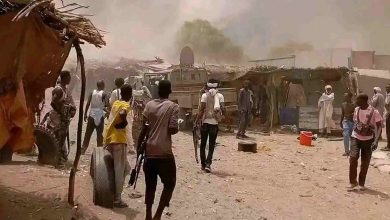
RSF Launches Largest Attack on El-Obeid in Western Sudan

Sudan Events – Agencies
The Rapid Support Forces (RSF) have launched drone strikes targeting military sites and infrastructure in El-Obeid, the largest city in the strategic Kordofan region of western Sudan, amid intensifying clashes between the Sudanese army and RSF forces across several parts of the region.
Residents said the RSF carried out its most extensive assault on facilities in the city — describing it as “the first of its kind since the war spread to Kordofan several months ago.”
Videos shared by local activists on social media showed low-flying drone attacks and the army’s ground defenses attempting to intercept them. Thick plumes of smoke and fires were visible at the sites hit by the strikes inside the city.
Siege of El-Fasher
Meanwhile, RSF militias continued shelling El-Fasher, the largest city in Darfur, with artillery fire as their drones hovered overhead. Multiple explosions were heard across the city, though their exact locations remained unclear.
A witness told Asharq Al-Awsat that RSF forces had been bombarding El-Fasher since early Saturday morning, with the shelling lasting for several hours before subsiding by midday. The presence of drones in the sky sparked panic among civilians.
The RSF has persistently attacked army-held areas—particularly the headquarters of the Sixth Infantry Division—in an effort to break army defenses and seize control of key positions in the city. However, the army has managed to repel these offensives.
In recent weeks, the RSF has made notable advances, pushing into the eastern and southern neighborhoods of the besieged city, as well as into the Abu Shouk refugee camp and the Muraaba 17, Awlad Al-Reef, Al-Wadi, Tambasi, and Makraka districts.
The army, for its part, continues to hold the city’s western sector and parts of Abu Shouk.
Observers attribute the RSF’s progress to its deployment of high-precision FPV (First-Person View) drones in coordinated attacks that pave the way for armored vehicle assaults—aimed at crippling army movements and breaching defensive lines.
UN Humanitarian Coordinator Visits Darfur
In a related development, UN Humanitarian Coordinator Denise Brown visited the Tawila area in North Darfur State—about 50 kilometers from El-Fasher—home to nearly 600,000 displaced people who fled the city and surrounding regions, including Khartoum, since the war erupted in mid-April 2023.
Brown described reaching Tawila as “complex and extremely difficult,” saying: “We had to change our route multiple times due to numerous frontlines within Sudan. Getting to our destination was incredibly challenging.”
She added that the journey took five days and covered 5,000 kilometers, involving three different countries, three aircraft, and three days of driving.
Brown said her visit aimed to strengthen humanitarian response efforts in Tawila, which serves as a key relief hub near El-Fasher.
“A humanitarian coordinator needs to be present on the ground, and this area’s proximity to El-Fasher makes it vital,” she noted.
She also highlighted the severe lack of funding for humanitarian operations in the region: “We have a strong UN team on the ground, but they are powerless to provide the services we should be offering because we simply don’t have the money.”
Civilians Flee the City
Brown reported that civilians continue to flee El-Fasher, with many women arriving in Tawila after losing their husbands and children to the fighting.
She shared the story of one woman who, along with her three children—including a malnourished infant—traveled for seven days on a donkey to reach Tawila.
“This is the tragic reality we must expect for people enduring such horrific conditions—forced to come to us instead of us reaching them,” she said.
Brown made an urgent appeal for an end to the war and for humanitarian access to the besieged population of El-Fasher: “Stop the violence. Stop the war. Let us through. We want to reach people where they are—not wait for them to reach us when it’s already too late.”
She condemned the use of sexual violence in the conflict, calling it “utterly horrific” and stressing that combating it is “an urgent priority.”
“The UN has documented patterns of conflict-related sexual violence being used as a weapon of war—including rape, gang rape, sexual slavery, and acts tantamount to torture,” she said.
Protecting Civilians
Brown emphasized the need to protect civilians: “Sudanese civilians are paying an unbearably high price for this violence—facing harassment, intimidation, rape, killings, and the collapse of essential social services.”
She noted that supply chains have been disrupted by poor or closed roads, driving food prices to unprecedented levels. Meanwhile, shortages of clean water and poor sanitation have fueled outbreaks of cholera and dengue fever.
“This situation is explosive—especially for young children,” she warned.
The UN’s humanitarian response plan for Sudan targets around 30 million people, yet funding remains at just 25 percent of the required total.