Dismissal of Civil Administrations Heads: New Internal Fractures Within the RSF Militia
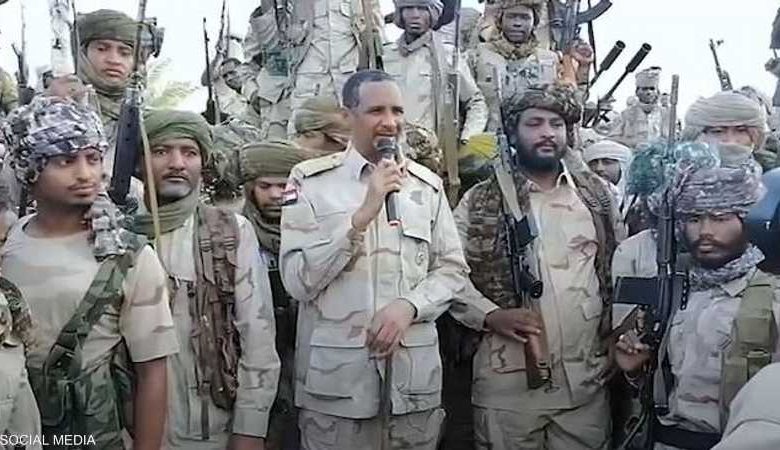
Internal divisions within the Rapid Support Forces (RSF) militia have continued, but this time in a new form. The militia’s commander, rebel leader Mohamed Hamdan Dagalo (Hemedti), has issued a series of new decisions that some observers consider a new turning point within the militia. Meanwhile, Mohamed Hassan Al-Ta’aishi, head of the illegitimate government known as Tasis, has regarded the decisions as a personal victory and a restoration of his standing. His appointment came after the establishment of what became known as the “Civil Administrations” in the 4+1 states, referring to the states under RSF control: East Darfur, Central Darfur, South Darfur, West Darfur, and West Kordofan.
Hemedti’s decisions included the annulment of the 2024 founding document governing these administrations, which had operated outside his direct authority and created overlapping jurisdictions, particularly in financial matters. Under their founding document, the administrations were responsible for collecting local fees from markets and vehicles travelling between cities and localities.
Al-Ta’aishi once described his position under these arrangements by saying, “I am a mayor without land,” indicating that the heads of the civil administrations in the 4+1 states held the real power over the distribution of revenues collected by their collection teams. The Prime Minister’s Office and the other ministries, including the Ministry of Finance and Economy, received only whatever shares the five heads of the civil administrations chose to allocate to them.
This arrangement created a persistent atmosphere of mutual suspicion and accusations of disloyalty between Al-Ta’aishi and the heads of the civil administrations in East, West, Central and South Darfur, as well as West Kordofan. Eventually, the founding document was annulled, the civil administrations were dissolved, and their heads were dismissed.
The main provisions of the decision issued by Hemedti on Friday, 30 October, annulled the 2024 Civil Administrations Document, dissolved all civil administrations established under it in the 5+ states, and dismissed the heads of the aforementioned state civil administrations:
* Yousef Idris Yousef – Head of the Civil Administration in South Darfur.
* Mohamed Idris Khater – Head of the Civil Administration in East Darfur.
* Abdulkarim Yousef Osman – Head of the Civil Administration in Central Darfur.
* Al-Tijani Al-Taher Karshoum – Head of the Civil Administration in West Darfur.
* Yousef Awad Alyan – Head of the Civil Administration in West Kordofan.
The decision to dissolve the administrations and dismiss their heads was also followed by the dismissal of the heads of the constituent councils, their advisers, executive officials and all other officeholders within those structures. All assignments and functional delegations were terminated.
It is worth noting that, under the now-annulled 2024 document, the civil administrations were popular bodies established to manage the affairs of local residents in areas controlled by the rebel RSF militia. Their responsibilities were limited to regulating markets, collecting revenues, administering land and organising its various uses, managing public facilities, and providing essential services to residents in those areas.
Sources closely familiar with the affairs of the rebel RSF militia told Asdaa Sudanese that the decision to annul the 2024 Civil Administrations Document, dissolve the administrations and dismiss their heads resulted from accumulated disputes between militia leaders and the heads of these administrations. Some of the latter had significantly expanded their influence because of their community relationships and the social constituencies to which they belonged.
The sources pointed out that the problems escalated following the establishment of parallel governing structures in Nyala for the so-called legitimate government, under which Mohamed Hassan Al-Ta’aishi was appointed Prime Minister of the Tasis government. His appointment was met with clear objections from the militia’s second-in-command, Abdelrahim Dagalo, with whom he became embroiled in repeated disputes. These ultimately left Al-Ta’aishi as little more than a supporting actor on a much larger stage, where the leading role remained confined to the Mahariya tribal circle, which controls the key levers of power within the RSF militia.
Al-Ta’aishi exchanged numerous accusations with Abdelrahim Dagalo and influential groups within the militia. Had Hemedti not insisted on retaining him in his position, he would have joined the growing list of officials who have resigned or defected, whose numbers have increased noticeably.
The sources added that another reason behind the annulment of the document, the dissolution of its institutions and the dismissal of their heads was the corruption allegations levelled against three heads of civil administrations in South, Central and East Darfur. These involved suspected financial corruption supported by conclusive evidence and corroborating indications, alongside other evidence.
Furthermore, confirmed information had emerged that all three had held contacts with Sudanese Army Intelligence and the General Intelligence Service. They were eventually detained by RSF intelligence. Information obtained by the latter reportedly confirmed their involvement in major financial irregularities, particularly concerning revenue collection from public markets, livestock markets and agricultural commodity exchanges, in addition to smuggling gold outside the channels and mechanisms directly controlled by the militia’s leadership.
The crisis was compounded by a lack of trust, which led to mutual accusations of disloyalty between the heads of the civil administrations and the Tasis Council of Ministers, headed by Mohamed Hassan Al-Ta’aishi.
The dismissal decision was also linked to these accusations of disloyalty. It stipulated that all dismissed heads of civil administrations must hand over the records, files, official stamps, funds, movable property and assets in their custody to the designated committees, without specifying the nature or composition of those committees.
The same sources who spoke to Asdaa Sudanese indicated that Hemedti had expressed considerable frustration over the contradictions and disputes that had emerged within the Tasis government, particularly between Mohamed Hassan Al-Ta’aishi on one side, and the heads of the civil administrations, Abdelrahim Dagalo and several influential figures from the Mahariya tribal group on the other.
This prompted him to issue his decision on Friday, 30 October. The decision itself contained certain contradictions. Its main provisions stipulated the annulment of the Civil Administrations Document, the dissolution of the administrations, the dismissal of their heads, the dismissal of the heads of the constituent councils, their advisers, executive officials and all other officeholders within those structures, and the termination of all assignments and functional delegations.
However, the concluding provisions of the decision contained vague wording that gave rise to further contradictions. These included a reference to the temporary “conduct of business”, whereby the existing authorities, which the decision did not identify, were assigned responsibility for maintaining operations to ensure the continued provision of services to citizens until the completion of the supplementary legislation required for decentralised and local governance.
The concluding provisions also prohibited the establishment of alternative administrations or councils, or the making of permanent appointments within the dissolved structures.
Overall, Hemedti’s decision of Friday, 30 October, suggests that the rebel militia commander has finally vented his frustration by annulling the 2024 document governing the civil administrations, dissolving them and dismissing their heads. He also sought to appease Al-Ta’aishi for reasons of his own, despite the continuing objections to him from Abdelrahim Dagalo.
Furthermore, the decision brought an end to the overlapping jurisdictions between the civil administrations and the Tasis government. This is precisely the crux of the crisis with Al-Ta’aishi and the underlying source of the problem.
Notably, the former heads of the civil administrations in West Darfur, Al-Tijani Al-Taher Karshoum, and West Kordofan, Yousef Awad Allah Alyan, each welcomed Hemedti’s decision in his own way. Karshoum stated that responsibility for change was not tied to holding positions, while Alyan described the dissolution of the civil administrations as an important step towards the transition to democratic decentralised governance.
The sources who spoke to Asdaa Sudanese considered that the two former heads of the civil administrations in West Darfur and West Kordofan had not faced the allegations levelled against their three colleagues, nor had they been arrested.
In Karshoum’s case, however, his interests require him to remain aligned with Hemedti for the rest of his life, as he is wanted by both domestic and international judicial authorities. A terrorism court in Port Sudan convicted him, alongside others including Hemedti, of involvement in the assassination of former West Darfur Governor Khamis Abdullah Abakar. The court sentenced him to death in absentia, along with several militia leaders.
He is also wanted by international judicial mechanisms. Human rights organisations that conducted a series of independent investigations concluded that he was implicated in the crimes committed in El Geneina, the capital of West Darfur State, in June 2023. Those crimes claimed the lives of thousands of people from the Masalit tribe, including former governor Khamis Abdullah Abakar. The investigations established that the alleged crimes fall under international criminal law and are subject to the jurisdiction of the International Criminal Court.
As for the second figure, Alyan, who belongs to the Falayita branch of the Misseriya tribe, he has faced considerable pressure from his tribal community and has apparently been left with no option but to seek Hemedti’s protection and remain his ally for the foreseeable future.
This is because of his negative stance towards the killing of the Falayita Misseriya Nazir, Abdelmonem Musa Al-Shuwain, who was assassinated in Nyala last year by a group affiliated with Abdelrahim Dagalo, allegedly acting on his direct instructions and in cold blood.
The killing reportedly took place simply because Al-Shuwain had objected to the militia’s failure to fulfil the rights of members of the Falayita Misseriya community, particularly their access to overseas medical treatment, a privilege enjoyed by members of the Mahariya group.
His outspoken remarks about these facts prompted Abdelrahim Dagalo, several days later, to order his assassination. The order was carried out.
His son, Musa, was killed a few days later as well. He had travelled to Nyala to establish the circumstances surrounding his father’s assassination and arrange his burial in accordance with the applicable religious procedures. Upon learning of his arrival, Abdelrahim Dagaloط reportedly ordered his immediate killing. That order, too, was carried out.