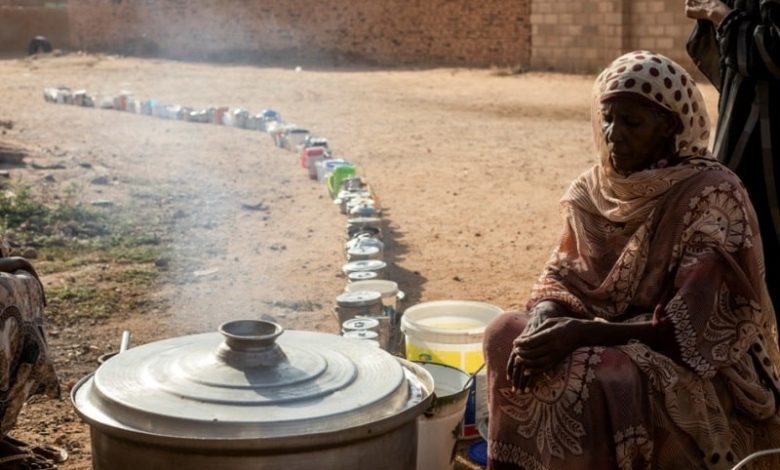
International NGO CARE, in an economic assessment released today, Tuesday, painted a bleak picture of living conditions in Sudan. The findings showed that approximately two-thirds of the households surveyed had no member earning a regular wage, while 91% lacked the capital needed to start any business activity.
The study, funded by the European Union, covered the states of Khartoum, South Darfur, South Kordofan, Red Sea, Gedaref and Kassala. It was based on a survey of 1,087 households and 622 young people, in addition to 358 qualitative interviews and focus group discussions. Although it did not directly measure the national unemployment rate, it highlighted the profound impact of the armed conflict that erupted in April 2023 on livelihoods and economic infrastructure.
According to the findings, only 33.3% of households had a member in regular paid employment, while 66.7% had no fixed source of income whatsoever. Average monthly household income stood at just US$136. Some 48.7% of households relied on unstable casual labour as their main source of livelihood, followed by small-scale trade at 41%, and agriculture at 19.1%.
The report identified the main obstacles to securing employment as a shortage of jobs, inadequate skills and educational attainment, and a lack of experience. As for entrepreneurship, 91.2% of respondents considered the lack of capital to be the greatest barrier, alongside rising prices and a shortage of equipment.
Mounting Shocks and Harsh Coping Strategies
Sudanese households are facing a series of overlapping economic shocks, most notably war-related displacement, reported by 76.9%; rising prices, affecting 71.5%; loss of income sources, at 48.8%; and the illness or death of the household breadwinner, at 32.6%. A substantial proportion of households were also affected by crop failures and livestock losses.
These pressures have forced families to adopt costly survival strategies. Some 64.8% resorted to selling household possessions, while 43.4% cut their consumption of food and basic necessities. Another 34.2% worked longer hours, and 30.9% were forced to borrow money. Some 18.5% sold productive assets, while a very small number reported resorting to risky practices to meet their basic needs.
Goods Available in Markets, but Purchasing Power Has Collapsed
Although 81.5% of respondents confirmed that basic goods were physically available in markets, 86% reported sharp price increases over the previous six months. This points to a crisis driven more by eroding purchasing power, rising transportation costs and insecurity than by shortages of supply.
Financial exclusion is further aggravating the situation. Some 30.8% of households lack access to any formal or semi-formal financial services, owing to the absence of identity documents or the lack of mobile phones.
Fragile Businesses and Women Among the Hardest Hit
Only 30.9% of households operate income-generating activities, most of which are informal and have little potential for expansion. Most women work in limited sectors, such as selling food and beverages and producing handicrafts at home, amid significant social and family constraints. Women’s economic participation remains weak, with approximately more than half of women not engaged in any paid work or commercial activity.
People with disabilities also face compounded barriers, including a lack of capital, physical access difficulties and the absence of assistive devices.
The report concludes that most economic activities currently operating in Sudan serve as day-to-day survival mechanisms rather than viable businesses capable of growth, amid the continuing conflict and the erosion of the Sudanese community’s productive capacities.