On the occasion of the opening of the Atelier Cairo exhibition.. Plastic artist Faisal Taj Al-Sir to (Al-Ahdath): On the occasion of the opening of the Atelier Cairo exhibition.. Plastic artist Faisal Taj Al-Sir to (Al-Ahdath):
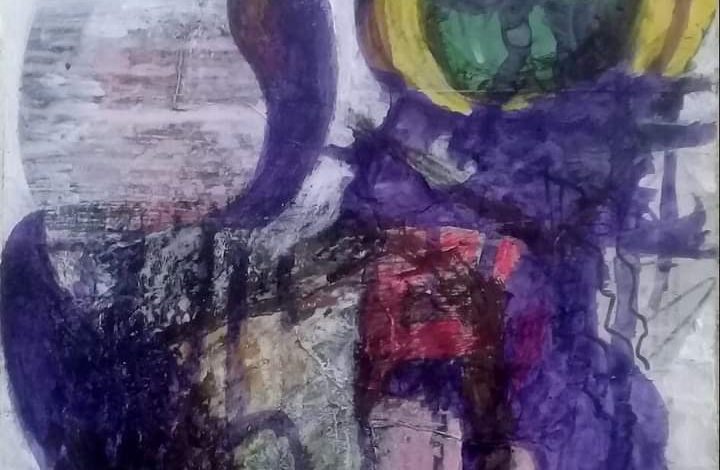
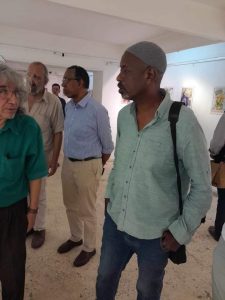
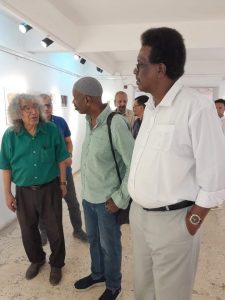
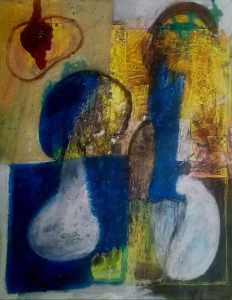
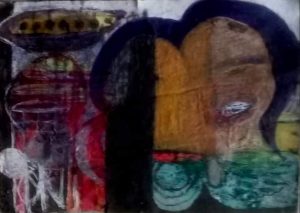
Ahmed Al-Ganaini, head of the Egyptian Plastic Artists Union, opened the exhibition of Sudanese artist Faisal Taj Al-Sir at Cairo Atelier. The exhibition was titled (Coastal Mood). Faisal paints on imaginary surfaces of his own world. He uses different materials with a paintbrush and dry pen lines that weave the soul into the body of the painting. He talks to us in this interview to shed more light on his plastic art experience.
Cairo – Muhammad Ismail
How were the first beginnings that made you a visual artist?
I got into art by studying geology, which I call Earth Art. We used to make slices of rocks and examine them under a microscope…amazing worlds were revealed to us. While my colleagues were busy determining the quality and proportions of minerals in the rock, I was contemplating those wonderful paintings.
Everything in geology led me towards art. After graduation, I studied by correspondence for a little while and did not finish, but I began to learn art on my own.
Tell us about your hometown, Port Sudan?
My birthplace is in Karmkul, that village at the bend of the Nile. As for Port Sudan, we settled there due to my father’s work in customs after a long tour that included all of ancient Sudan. My relationship with the sea became stronger and it became clear to me that I have a marine temperament. I prefer being on the coast more than anywhere else.. As for Port Sudan, as a city, I am not particularly emotionally attached to it. Port Sudan has an imagination that is much better than reality and is almost ideal. This is Port Sudan that I prefer to live in.
You are interested in improving your work. How does the recipient see these works?
I always say that art is alienation within alienation… the alienation of art in general in our country and people not accepting it easily, in addition to its second alienation, delving into experimentation and innovation, striving towards freedom… the more its freedom, the greater its alienation.
As an artist, I do not care at all whether people accept or not accept the art I make while I work. In fact, I exile myself, making room for the inner world to come out as it pleases. Matters related to the recipient come after that.
Your exhibition is called Coastal Mood. What is the significance of this name?
My latest exhibition, A Coastal Mood, reflects multiple moods over more than twenty years. The coastal mood is that amazing and mesmerizing mixture of lives struggling to survive and crumbling times with no support other than color. I still walk the city streets in the middle of chaos like an enchanted person. This has given me the habit of contemplation and sharp sensitivity, like a knife… all of this was reflected in my work.
Every artist has a specific cause and message to humanity. How did you translate the issue of the ongoing war in the homeland through colors?
The war presented us as artists with a violent shock and a terrible defeat for all our aesthetic projects. We were defeated, but we did not surrender. We worked from the beginning to absorb the shock of the war by holding workshops and exhibitions. All of this was led by our dear friend, the artist Issam Abdel Hafeez, and all of this continued after his departure to Kenya. A large number of displaced artists from Khartoum participated in exhibitions, workshops and seminars, and I think we succeeded to some extent in establishing an alternative platform for what was destroyed in the capital. Of course, the atmosphere of war dominated our work in that period, and I remember that I used to pour a lot of blood on the scratched and patched surfaces. Most of it is mercy for the eyes. I also received expected help from black and white and their mixing. The colors returned to the painting after the concerns calmed down a little. There is a bewildering indifference that prevails towards the war, as life finally takes its hold.
Every artist has a school. What school has a major influence on your work style?
If I found an art school called freedom, then it is the one that was influenced by it… In the name of freedom, I practice art. There are absolutely no restrictions or limits to what can happen in the painting, and the pleasure resulting from that cannot be described. There is truly freedom… it is within this magical world hanging on the wall. A large part of the artist’s torment is not being able to make the recipient taste that freedom.
Is this exhibition, which carries a coastal mood, a message to present a vision of the homeland?
This is my second exhibition in Cairo. The first was in 2005, and I showed here works that I brought with me from Sudan. I was keen to introduce myself here. I am almost unknown here except among a few artist friends, male and female, despite my frequent visits to Egypt since my studies. My degree is in geology from Assiut University. If I am required to adopt a message, my artistic practice will go beyond that message. It will go beyond the homeland or any other concepts I adopt. I am primarily concerned with revealing my inner world first to myself and then to others. It is a personal message, as you can see, but it is characterized by honesty. If this has any value, the homeland may appear through this revelation in an unexpected and indirect way, of course. This always happens.
What is your outlook and thinking when drawing?
I draw all the time.. I draw while I am dreaming.. I do not think about anything while I am drawing.. I have to go away so that the resident artist inside can come and do his work.. For me, drawing has become an involuntary process.. it is something similar to breathing.
What feeling or emotion dominates you when you draw, or do you draw in all circumstances?
In fact, I have been practicing art for years in a stifling atmosphere of scarcity due to the country’s well-known conditions, so I turned everything I could into an artistic area. My last exhibition in Port Sudan, Another Life, was made up of cardboard pieces thrown in the street and old sketches that developed into paintings after layers of paint covered them. Color…everything will work if you catch your imagination.
Every artist has a message he believes in and a cause he fights for. What is your message and what is your cause?
My main issue is freedom. It pains me that this world results in its cruelty with all this bravado and indifference. The government has become an employee in favor of cruelty, oppression, persecution and indifference. I read the confusion, pain and lack of understanding in the eyes and I wonder, when this humiliation will end?
What about group exhibitions?
Yes, our collective exhibitions in Port Sudan have not stopped since July 2023, and the last exhibition was the Ajyal exhibition at the Customs Club. The important exhibition among them is the Safe Corridor exhibition, which we held in the building corridor in front of my office due to the absence of an exhibition hall.
What about Cairo Atelier?
Cairo Atelier came at the suggestion of a writer friend and I agreed without thinking. I needed to start with something, from anywhere.