The Democratic Bloc… “What Kind of Soup Is This?!”
As I See
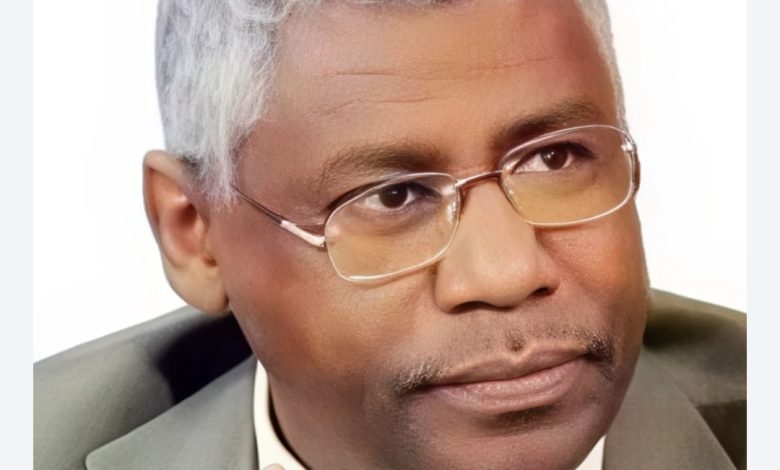
Adil El-Baz
1
This is a phrase that the distinguished journalist Ms. Suhair Abdel Rahim often repeats to me. Whenever the contradictions among political forces multiply, and their conflicting statements and incomprehensible positions pile up, she calls me and asks just one question: “Professor, what kind of soup is this?” And I laugh.
I remembered that phrase yesterday as I was reading the contradictory statements and declarations issued by what is falsely called the “Democratic Bloc.” I found myself repeating: “What kind of soup is this?” The farce in which this bloc is now engaged proves that this group is neither a bloc nor democratic. Rather, it is merely a miscellaneous gathering with neither a head nor a meaningful bond connecting most of its components. Its positions and decisions have become a source of ridicule.
2
Do Sudanese not have the right to despise political parties and lose hope in finding any good in them? The recklessness practiced by these parties and their lack of principles are precisely what discourage people—especially young people—from joining any of these organizations.
These “funeral phantoms” that call themselves political parties constantly lecture us about democracy while practicing the highest levels of political absurdity. Internally—and I am not even referring to their institutions—they do not understand the meaning of democracy. For decades, they have known no elections. The party president or leader remains an eternal ruler, replaced only when the Angel of Death personally arrives.
Just look at them: peacocks perched atop their parties. No one elects them, and no one holds them accountable. There is no clearly identifiable party membership, no transparent sources of funding, and no sound organizational structure. It is chaos from beginning to end. No policies, no programs, no effective political action—nothing but amorphous entities and voices echoing in the public sphere without impact. Strangely enough, all of them claim to represent the people and speak on their behalf.
3
Yesterday, news reports stated:
A group consisting of 14 organizations within the Democratic Bloc announced its refusal to participate, while another group consisting of five organizations insisted on participation and affirmed that its delegation in Addis Ababa is the bloc’s official representative.
I felt nauseated reading this report, which embodies the absurdity practiced by the so-called “Democratic Bloc” in its clearest form.
In the morning, Mr. Minni Minnawi, in his capacity as the bloc’s political official, issued a statement announcing the Democratic Bloc’s participation in the Addis Ababa meetings and confirming that its representatives were heading there to attend the gathering convened by the “Quintet” (the United Nations, IGAD, the African Union, the Arab League, and the European Union).
That same afternoon, however, another statement was issued—signed by 14 components of the Democratic Bloc itself—rejecting participation.
Imagine this single “bloc”: the political secretary issues one statement supported by five organizations, while the chairman and 13 organizations issue another statement on the very same day, effectively nullifying the statement of the bloc’s own political secretary.
What kind of soup is this?!
This scene is not merely a passing disagreement. It is conclusive evidence of the absence of the most basic requirements of collective action: coordination, discipline, and credibility.
I do not care about the political positions of either side. Nor do I care about the Quintet meetings or the failed games of those international actors who have spent years moving from one conference to another in a futile cycle that seems to produce little beyond the collection of donor funds. What concerns me is the absurdity practiced by the Democratic Bloc itself.
Whatever disagreements exist within the bloc should be resolved internally. Whether it chooses to participate in the Addis Ababa meeting or not, it should do so with a unified position that preserves its dignity and credibility. To appear in such a disgraceful manner is truly unfortunate.
I do not understand why the bloc insists on operating while carrying so many contradictions within it. Would it not be more honorable for it to split, with each side pursuing its own path, rather than continuing this farce?
4
What is even more laughable is that some components of the bloc have no objection to accepting “Tasis” and its Janjaweed leader—who, according to the author, continues to be responsible for killings in Darfur—into a civilian political dialogue. Others, meanwhile, do not recognize “Tasis” at all.
Some accept the agenda proposed for the Addis Ababa meeting, despite having neither participated in drafting it nor even seen it, while others reject it outright. Part of the bloc approves of the participants, while another part rejects them.
Take note—this is supposedly one bloc!
One bloc with multiple delegations, each singing its own tune. One delegation will engage in meetings with Somoud and Tasis, while another will address the gathering—or the Quintet—via Zoom.
This is one bloc…
What kind of soup is this?
5
This publicly displayed disorder is not merely a procedural disagreement. It is the manifestation of a deep strategic failure that strikes at the heart of the principle of collective action.
If the bloc is incapable of agreeing on whether to participate or not participate, or of adopting a unified position toward other political forces, then how can it claim to represent the Sudanese people when it cannot even represent itself as a united body? And how can it hope to engage in a comprehensive national dialogue or contribute to building a state?
Given Sudan’s current ordeal, the country cannot afford half-hearted positions and fragile alliances that crumble at the first real test.
The most honorable course for this Democratic Bloc would be to reconsider its existence as a single entity. Continuing in its current form only deepens the Sudanese people’s frustration, resentment, and loss of hope in any genuine political reform in the country.