The Perilous Journey of Displacement from Darfur to Chad Through Corridors of Fire
Report – Sudan Events
On the night El Fasher fell, Mohammed Adam Hamed, one of the survivors from the “First Degree” neighborhood, found himself with no option but to flee westward, setting out on foot toward the town of Tawila, some 68 kilometers away.
The road was strewn with corpses, some partially buried by sand. He carried only what he could lift on his shoulders and was forced to pay a ransom of 10,000 Sudanese pounds in the area of Qarni before finally reaching relative safety.
Hamed’s journey is emblematic of a long arc of suffering endured by thousands of others whom war has driven from their homes, turning their flight into part of what is now the world’s largest displacement crisis.
Since fighting erupted in Sudan in mid-April 2023, nearly 13 million people have been displaced, including more than 7.3 million internally displaced within Sudan and over 4.3 million who have fled to neighboring countries, according to estimates by the UN High Commissioner for Refugees (UNHCR).
The Collapse of El Fasher
With the fall of El Fasher, the capital of North Darfur State, to the Rapid Support Forces (RSF) on April 26, 2025, the region entered a new phase of collapse. An unprecedented wave of mass displacement followed as basic services disintegrated, hospitals shut down, and the state all but vanished from view, leaving tens of thousands of residents with no choice but to flee westward.
From El Fasher, the displacement route runs through Tawila and Niertiti in the Marrah Mountains, then on to Zalingei and El Geneina—once a bustling commercial hub, now a city largely emptied of its original inhabitants.
Walid Mukhtar, a former nurse at El Fasher Hospital, says markets have fallen under RSF control, with armed men roaming on motorcycles. Infrastructure has been destroyed, and fuel trading has spread across the streets.
Speaking to Al Jazeera Net, Mukhtar adds that entry and exit gates have turned into extortion points, where drivers are forced to pay “fees” entirely outside any legal framework.
El Geneina—once known as the “city of safe haven”—has today become an open gateway toward Chad, as people flee a devastating war that has ravaged the area.
The Exile Station
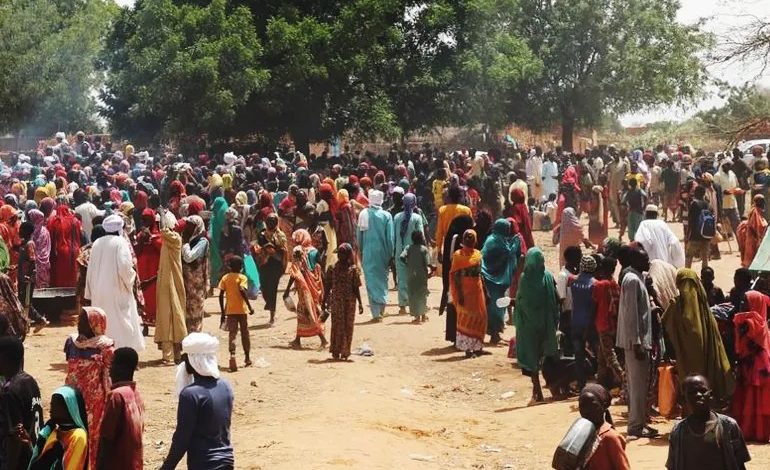
Upon reaching the border town of Adré (via Adkong on the Sudanese side), a new chapter of hardship begins. Vehicles packed with families arrive at fuel markets, unload their belongings, which are then transferred onto donkey carts. The displaced themselves are forced to walk on foot toward the Chadian town of Adré, their bodies exhausted and their spirits weighed down by grief.
From the Ardemi camp in eastern Chad, Mustafa Barrah, director of the local relief organization Yad Al-Khair, says: “Every day we receive dozens of people fleeing the hell of war in Darfur, most of them from El Fasher. They arrive recounting a deadly gamble they chose over remaining under the constant threat of death in their cities.”
Barrah told Al Jazeera Net that the route from El Fasher to Chad is an almost unimaginable risk. Women, children, and the elderly trek long distances, and over the past month alone, 68 cases of rape were documented at the Bami Jura camp following the city’s fall. Some families pay everything they own to board overcrowded trucks, only to be forced later to disembark and walk along rugged paths, abandoning their belongings behind.
He describes the condition of new arrivals: “They come barefoot, with swollen and wounded feet, torn clothes, and children suffering from dehydration and acute malnutrition. We try to provide first aid, but the wounds of memory run deeper. They speak of fleeing under shelling, of scenes they cannot forget, and of loved ones they lost—or were forced to leave behind.”
Local reports indicate that women and children make up around 70% of new arrivals to Chad, many of whom suffer from acute malnutrition, amid rising cases of sexual violence and exploitation along displacement routes, and a near absence of protection and psychosocial support programs.
Mounting Challenges
Social consultant Dr. Mohammed Suleiman Atteim, who recently arrived at refugee camps in Chad, says large numbers of El Fasher residents have crossed into Chadian territory, most settling in the Ardemi and Tulum camps.
He told Al Jazeera Net that humanitarian organizations are providing limited assistance that falls far short of meeting basic needs, leaving refugees increasingly reliant on self-help initiatives—such as the “El Fasher Takiya,” relocated by volunteer Mohyeddin Shogar, which provides daily meals despite scarce resources.
According to UNHCR, Chad is hosting more than one million Sudanese refugees amid fragile infrastructure and limited basic services, while still receiving hundreds of new arrivals each week.
The Road of Death
Parallel to the westward exodus, some residents have chosen an eastern route through Kordofan toward the city of Ad-Dabba, despite its extreme danger. This path is fraught with risks, lined with the charred remains of vehicles destroyed by drone strikes or armed ambushes.
Abakar Suleiman, a displaced man from El Fasher who recently reached Omdurman, told Al Jazeera Net: “We traveled from Nyala to Al-Lait, then Umm Badr, Al-Zuraf, and finally Al-Mufrid to Ad-Dabba. The road is extremely dangerous, and even women are banned from traveling on it. I had to disguise myself as an assistant on a truck belonging to an international organization to make it through.”
Amid this tragedy, a parallel economy has emerged, feeding on the suffering of those fleeing. Transportation costs have soared to astronomical levels, reflecting systematic exploitation of people’s desperation to survive. Fares now reach:
From Tawila to Golo in the Marrah Mountains: 100,000 Sudanese pounds (about $166).
From Golo to Niertiti: 70,000 pounds (around $116).
An additional 100,000 pounds to reach Zalingei.
Those taking the El Geneina–Adkong route may pay nearly 200,000 pounds (about $332).
Drivers justify these prices by citing the dangers they face, including the risk of having their vehicles confiscated by RSF elements, forcing them to pay steep “fees” at checkpoints—costs ultimately passed entirely onto passengers.
What is unfolding in Darfur is not a sudden development, but the result of accumulated conflicts that worsened after the outbreak of war between the Sudanese army and the Rapid Support Forces on April 15, 2023. In the absence of central authority, cities have turned into open arenas for looting, killing, and extortion.
The Rapid Support Forces say they “do not target civilians,” yet Al Jazeera Net was unable to obtain an official comment regarding the dangers faced by those fleeing through areas under RSF control, or the allegations of abuses against civilians accused of cooperating with the army or joint forces.
In this light, the journey of displacement from Darfur to Chad becomes more than a crossing of geographical borders—it is a continuous breach of barriers of fear and pain. The Chadian border is merely one stop in a much longer journey of suffering, where the calamities of refuge and poverty replace the horrors of war and the road.
Source: Al Jazeera Net