Threats Have Become Real… The Chadian President Pitches His Tent on the Border with Sudan
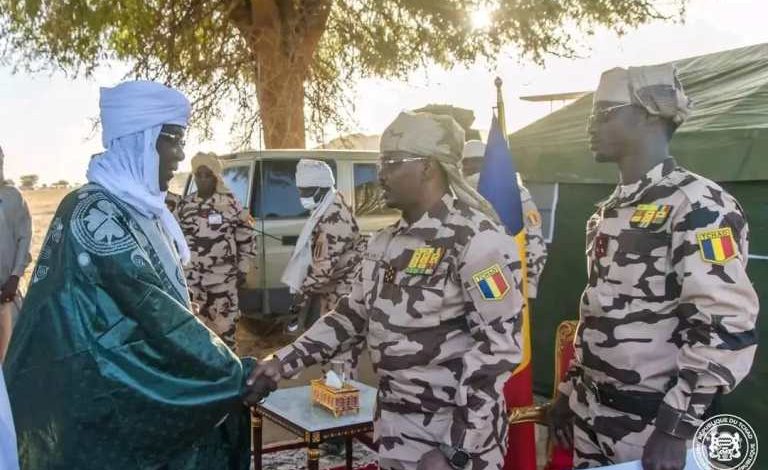
As events escalated in eastern Chad, Chadian President Mahamat Idriss Déby Itno found no option but to board a helicopter that took him to Dar Tama in Wadi Fira State, in eastern Chad, where he set up his tent in hopes of halting a danger he fully understands and recognizes the risks of.
In the desert of Dar Tama, Mahamat Idriss Déby—locally known as “Kaka”—pitched his tent, summoned tribal leaders, and entered negotiations aimed at stopping inter-tribal fighting and preventing the infiltration of militia fighters from Sudan with their weapons and combat vehicles. The violence had erupted following an incident in which members of a tribe allied with the Janjaweed assaulted a girl who was on her way to her tribe’s settlement, a tribe aligned with the Sudanese army. She was attacked and had her leg broken solely because her tribe supports the army. The incident ignited battles that left many dead, spread chaos across eastern Chad, and made identity-based killings widespread and seemingly permissible.
It has become common to see armed groups moving from place to place, attacking others and attempting to kill them, including women and children. Over time, the militia has introduced combat vehicles into the region to attack communities whose tribes have allied with the government in its war against the Janjaweed.
It has become evident that eastern Chad—having in recent years served as a corridor for weapons flowing to the Rapid Support Forces militia—is no longer fully under the control of the Chadian state. This is compounded by the growing influence of certain generals and their alliances with smuggling networks. With RSF militia forces entering markets and towns in combat vehicles and with advanced weapons now in the hands of local populations—while the Chadian army itself lacks access to such equipment—the situation has further deteriorated.
Moreover, areas stretching from eastern to southern Chad have turned into hubs for arms and drug trafficking, as well as safe havens for unruly groups from multiple countries taking advantage of border instability. At present, no one fully controls the Sudan–Chad border, making it an open corridor for drugs, weapons, and more.
Mahamat “Kaka” personally witnessed this reality and heard directly from local residents, leading him—for the first time—to acknowledge that the Rapid Support Forces militia has harmed his country and threatened its national security. He heard firsthand accounts from locals about what the militia had done to them and their villages, and from tribal groups about how the militia incited them to attack tribes that supported the Sudanese army.
This prompted him to summon military leaders, headed by General Othman Bahr Itno, commander of the joint Sudanese–Chadian force, and hold a meeting with them. According to sources, Déby listened to their assessments of recent developments and their concerns regarding his previous alliance with the Janjaweed. They reportedly outlined the growing dangers posed by the widespread availability of weapons among tribes, the continued influx of arms by the militia, and the return of fighters trained on advanced weaponry who are now inciting local communities and fueling tensions that could lead to a full-scale civil war.
As a result, Déby spoke candidly about the need to collect weapons, pursue militia elements who have returned, completely prevent militia members from entering Chad, close the border to them, and block any supplies from leaving the country. He warned that the militia is no longer a reliable partner and called for its members to be pursued—even if they cross back into Sudan. He also advocated for the creation of a buffer zone along Chad’s borders to prevent the war from spilling into his country, warning that what is happening now are early signs of such a spillover.
Meanwhile, Mohamed Al-Kanim, a Chadian political researcher and journalist, stated that these developments prove the flaw in the idea of aligning with the militia from the outset. While such alliances may yield temporary gains under certain conditions, he said, they ultimately lead a country toward ruin—a reality that Mahamat “Kaka” now sees and hears unfolding along the Sudanese border.