Reports
International Criminal Court Prosecutor: Majority of Evidence Proves Charges Against “Kushayb”
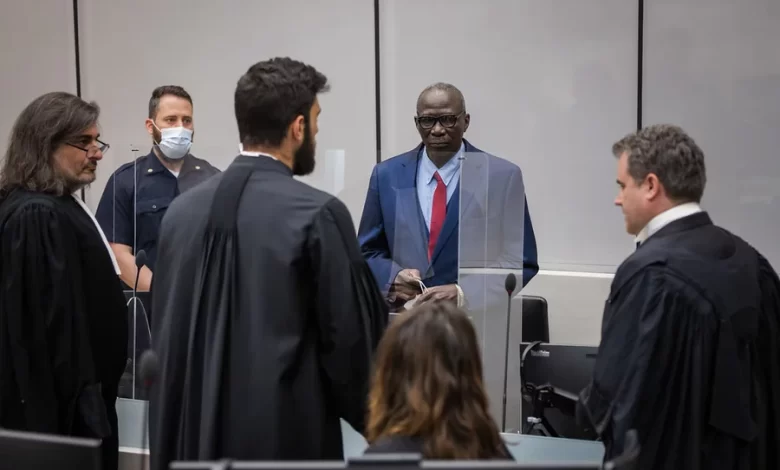
With the commencement of closing arguments against the accused, Ali Abdel-Rahman, also known as “Ali Kushayb,” for war crimes and crimes against humanity in the Darfur region (western Sudan), the Prosecutor of the International Criminal Court (ICC) informed the judges that “the majority of evidence shows that the defendant’s actions and behavior prove he committed the crimes outlined.”
The Prosecutor said that Ali Abdel-Rahman, a suspect in the first war crimes trial related to the Darfur conflict that erupted two decades ago, was a feared militia leader who ordered atrocities, including murder, rape, and looting. Abdel-Rahman has pleaded not guilty to overseeing thousands of government-backed Janjaweed fighters during the height of the fighting in 2003 and 2004. His defense team argued that he was not the leader of the militia, also known by his alias “Ali Kushayb.” The defense has previously described him as a “scapegoat” presented by the Sudanese government to cover up the involvement of the primary perpetrators, including ousted President Omar al-Bashir, former defense minister Abdel-Rahim Mohamed Hussein, and former interior minister Ahmed Haroun.
Prosecution Proves Its Case
In his closing statement on Wednesday, ICC Prosecutor Karim Khan stated that during the two-year trial, prosecution witnesses provided “detailed accounts of mass killings, torture, rape, targeting of civilians, and the burning and looting of entire villages,” and that the prosecution had proven its case beyond a reasonable doubt.
The closing arguments mark the conclusion of the first and only trial conducted by the ICC concerning crimes committed in Sudan since the Security Council referred the case to the court in 2005. There are still outstanding arrest warrants against senior Sudanese officials from the era of President Omar al-Bashir.
The conflict in Darfur initially erupted when non-Arab rebels took up arms against the Sudanese government, accusing it of neglecting the remote region in the west of the country. In response, the Sudanese government mobilized mostly Arab militias known as the “Janjaweed” to suppress the rebellion, resulting in a wave of violence that the United States and human rights groups have described as amounting to genocide.
Since the ICC trial began, conflict has flared up again in Darfur, and the ongoing 20-month conflict between the army and the paramilitary Rapid Support Forces has evolved into a more deadly battle, with ceasefire efforts faltering. In June of this year, the ICC Prosecutor announced that investigations are also underway into current allegations of war crimes and crimes against humanity in Darfur.
The closing arguments are set to continue until December 13 at the court’s headquarters in The Hague, Netherlands.
Sudanese Government Armed the “Janjaweed”
Khan noted that the Sudanese government and others were arming the Janjaweed militia to fight the rebellion. However, the victims in this case “were not rebels, but civilians.” In his argument, he stated that the court had previously heard from 81 witnesses “who spoke about mass killings, rapes, burning, destruction of entire villages, and the displacement of the Fur people, who are still unable to return to their areas today.”
He added that hundreds of men from the Fur tribe were detained and tortured in Mukjar and Deleij in central Darfur, all at the hands of the defendant in this case, Ali Kushayb. Khan further said, “We presented the court with evidence of the rapes committed by the Janjaweed, which were part of a strategic policy by the Janjaweed and the Sudanese government against the Fur people.”
The Prosecutor concluded that all criminal charges against Ali Kushayb “have been proven in court, and we hope the court will consider the reliable evidence through a fair trial.” He affirmed that the defendant “is responsible for crimes committed in the areas of Kutum, Bindisi, Mukjar, and Derij during the conflict in the Darfur region.”
Khan described this trial as a glimmer of hope for those who lost their relatives and properties and have been waiting for justice for 20 years. Ali Kushayb faces 31 charges related to war crimes and crimes against humanity, alleged to have been committed in the Darfur region of Sudan between August 2003 and April 2004 in the areas of Mukjar, Bindisi, Deleij, and Kadoum in central Darfur.
The trial of Kushayb began on April 5, 2022, following his surrender to the court in June 2020. During the trial, the court heard from 56 witnesses, and the prosecution closed its case on June 5, 2023.