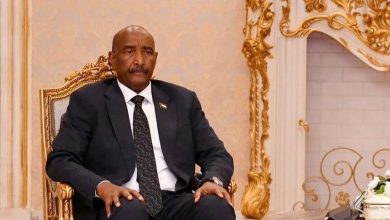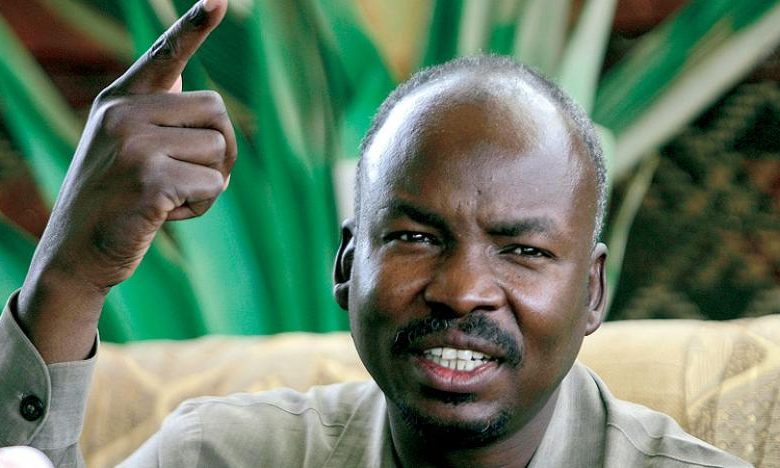
National Congress Party Chairman Ahmed Haroun has denied the existence of any organizational relationship between his party and the President of the Transitional Sovereignty Council and Commander-in-Chief of the Armed Forces, General Abdel Fattah Al-Burhan. He stressed that the relationship between the two is no more than the normal interaction between a head of state and political forces.
In an extensive interview with journalist Rabie Siraj on the Sudan Podcast programme, excerpts of which were carried by Sudanese media outlets on Friday, Haroun said that his party has no organizational affiliation with Al-Burhan and that there is no “umbilical cord” connecting them. He added that he holds no personal position against him, noting that Al-Burhan was not a member of the security committee that planned the overthrow of the former regime.
Haroun explained that the two sides are currently united by their confrontation with what he described as an attempt to target the Sudanese state. He likened the situation to passengers aboard a boat in danger of sinking, who have no choice but to cooperate and bail out the water to reach safety. He added that the relationship between Al-Burhan and the National Congress Party does not fit the famous statement by the late Islamist leader Hassan Al-Turabi: “I go to the palace as president, and I go to prison as an inmate.”
A “Hybrid Political System”
Discussing the future of governance, Haroun proposed the idea of a “hybrid political system,” calling for deliberations on a framework that accommodates the relationship between civilian forces and the military institution.
He argued that the difficulties encountered by party-based political experiments, coupled with the repeated return of the military to power, necessitate a reassessment of the political system’s structure and the search for a model suited to Sudan’s circumstances. However, he did not provide a detailed vision of how powers would be distributed or how such a model would be implemented.
2014 Dispute with Hemedti
The interview also addressed Haroun’s dispute with Rapid Support Forces Commander Mohamed Hamdan Dagalo, known as Hemedti, during Haroun’s tenure as governor of North Kordofan State in 2014.
At the time, Haroun gave the militia 48 hours to leave the state following alleged abuses committed by some of its members in the city of El-Obeid. He said he stood by his decision despite interventions by officials in Khartoum seeking to extend the deadline. He reportedly presented the leadership with a choice between enforcing the decision and accepting his resignation.
According to Haroun, the force, which comprised more than 460 military vehicles, withdrew before the deadline expired. Former President Omar al-Bashir subsequently intervened to contain the dispute. These details represent Haroun’s own account of the events.
Attack on the “Qahatites” and Criticism of Salah Gosh
Haroun attributed what he described as attacks on the National Congress Party and Islamists to Al-Burhan’s susceptibility to media propaganda. He noted that these campaigns were not orchestrated by the “Qahatites” alone, but were also backed by international media and intelligence operations.
Commenting on former General Intelligence Service Director General Salah Gosh, Haroun likened him to a protagonist in an Indian film who dies in the opening minute. He criticized what he considered recklessness and impulsiveness inconsistent with the nature of security work.
Haroun said Gosh has excessive confidence in his own abilities and a desire to maneuver and play multiple sides against one another. He also referred to personal grievances stemming from his dismissal from the intelligence service and his exclusion from the security advisory office.
The Fall of the Salvation Regime and Other Behind-the-Scenes Details
Regarding the fall of the Salvation regime, Haroun said he could not conclusively determine whether betrayal or external influence had played a role in what happened.
He cited the events in Iraq, questioning whether the late Iraqi President Saddam Hussein could be described as an agent simply because, according to Haroun’s account, the US ambassador had encouraged him to invade Kuwait.
He also discussed behind-the-scenes details surrounding the establishment of the Rapid Support Forces and the political reassessments he said he had undertaken during his detention at Kober Prison.
The Course of the War and the Future of Negotiations
On the war, Haroun expressed his belief that Sudan had passed through the most difficult stage and that only a few steps remained before achieving a major victory. However, he stressed that wars do not end through fighting alone and that negotiations are an inevitable stage, with the difference lying in whether they are entered from a position of military strength or weakness.
He emphasized the need to bring the existence of the Rapid Support Forces militia to an end, describing it as an entity with which coexistence would be difficult.
He linked an end to the war to the cessation of what he described as aggression by the parties sponsoring the militia, and to their realization that they could not achieve their political objectives through military means.
Haroun described the militia’s allies as a loose coalition driven by shared interests, comprising foreign countries and Sudanese political parties.