Sudanese Certificate Exams (2023–2024): A Journey Fraught with Risks and Errors
Sudan Events – Agencies
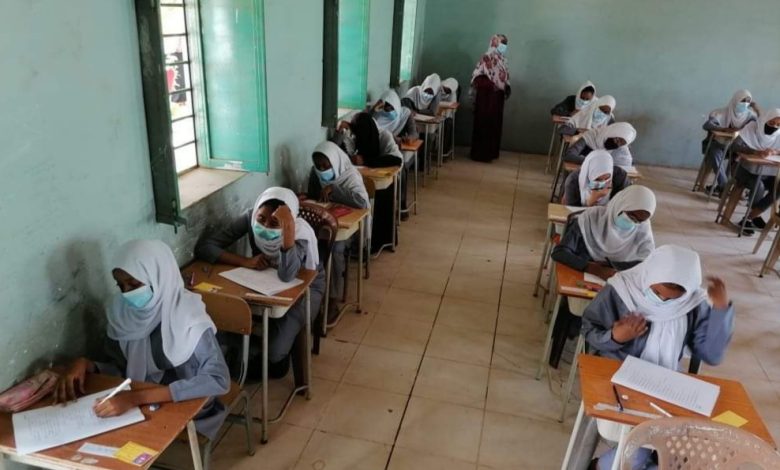
On June 29, Prime Minister Kamil Idris announced the commencement of the Sudanese Certificate Exams for the postponed batch of 2023–2024. A total of 209,273 students are sitting for the exams, including 22,000 outside Sudan.
According to a senior source speaking to Atar, this edition of the exams includes 2,100 examination centers, 20 of which are abroad. The largest foreign center is in Cairo, consisting of 11 sub-centers. In Egypt alone, there are 13,000 candidates in Cairo and Giza governorates, 1,200 in Alexandria, and 200 in Aswan. In Ethiopia, 34 students are sitting the exams; in Libya, there are 127 female and 66 male candidates. In Saudi Arabia, the Riyadh center (overseen by the embassy) hosts 2,181 candidates (1,200 females and 981 males), while the Jeddah consulate center has 1,555 candidates. In Muscat, Oman, 56 students are taking the exams.
To avoid issues caused by using “emergency numbers” in previous exams, the education authorities and external centers were provided with “extra blank seating numbers” to register late-arriving students, accounting for displacement movements and war-related disruptions.
The source stated that the Ministry’s Exam Administration began preparations for the 2023–2024 exams immediately after announcing the 2022–2023 results. A special operations room was formed to work around the clock in these extraordinary circumstances. These efforts resulted in smooth and timely printing of exam papers, which were then successfully distributed along with seating numbers to all centers inside and outside Sudan.
Notably, three states—Khartoum, Al Jazirah, and Sennar—rejoined the exams this year after being largely absent from the previous session. Coordination took place between education directors and local leaders in the city of Dilling, South Kordofan, to ensure the exams were held and to provide logistical support, including 21 exam centers across 11 locations, serving 3,032 students, which represents over 50% of the state’s candidates.
The source added that competent Sudanese teachers who had emigrated were appointed as senior supervisors at foreign centers. Exam eligibility follows a flexible system without age restrictions, allowing students to take the exam as long as they hold a basic or intermediate school certificate from at least three years prior. The Sudanese examination system is very accommodating, even accepting candidates over 23 years old regardless of the grade last studied.
Regarding disparities among students due to war conditions, the source explained that since 1995, Sudan has adopted the “standardized scoring system,” which assesses students relative to their peers sitting the same exam, a globally accepted system.
In Darfur, students have no choice but to travel or flee to other states where the exams are held, as the Rapid Support Forces (RSF) control large parts of their regions. According to the source, the Ministry facilitated registration procedures and provided accommodation and meals for Darfuri students hosted by Northern, River Nile, and White Nile states, with support from the Ministry of Education and UNICEF. From the start of registration, students from Central, North, and South Darfur registered under the names of their home states.
Exams in Chad
Sudanese students in Chad face enormous challenges, including lack of official documentation (such as national ID or refugee cards), missing registration information, scarcity of textbooks, and logistical and living hardships during the exam period.
On June 24, the Chadian government agreed to allow the Sudanese Certificate Exams to be held within its borders. However, since the exams began just five days later, Sudan’s embassy in Abéché announced on June 29 that an alternative exam session would be organized for Sudanese refugees in eastern Chad at a later date—confirmed by Atar’s source.
Back in December, Chad had denied roughly 6,000 students—who had fled West Darfur and other border regions—the chance to sit for the then-scheduled exams. Aisha Al-Badawi, education representative in East Chad camps, affirmed ongoing efforts to register students multiple times and encourage them, despite repeated postponements and cancellations. Proposed exam centers in accessible locations were suggested but not yet officially approved. Prior to the exams, a follow-up committee of teachers and parents was formed, and revision sessions began immediately.
Nonetheless, things remain difficult. Al-Badawi told Atar that students face serious challenges, including the lack of documentation (e.g., national ID and refugee card), incomplete registration data, absence of textbooks, and difficult living and logistical conditions during exams.
She added that the camp leader, Hamed Abdul Rahman, proposed accessible exam centers in Touloum, Dogoba, Ardimi, Kolongo and Melih, and Kariari camps—but as of the meeting date, no official response had been received.
Hope Amid Danger
In this round of exams, hope returned for Tasneem—but it remains hope fraught with danger. She had to cross the desert northward from her hometown to sit the exams in Atbara, River Nile State.
Previously, sitting the Sudanese Certificate Exams had been a dream for Tasneem from Nyala, South Darfur, but the exams there were canceled.
This time, she made the journey: from Nyala through Ed Daein in East Darfur, then Umm Badr in North Kordofan, through the desert to El-Dabba in Northern State, and finally to Atbara—on a twelve-day trip. Speaking to Atar, Tasneem said:
“I faced countless obstacles on the way to Atbara. From Nyala to Umm Badr, we were harassed and searched at every checkpoint. RSF soldiers robbed us of all our money and repeatedly demanded we return to Nyala, as if they wanted to imprison us in the hell of war.”
She added:
“Our car broke down in the desert, and we stayed two full days with hunger and thirst threatening our lives. Near El-Dabba, army vehicles found us and gave us first aid—bringing back a bit of our lost strength. The price of freedom and safety was giving up everything we owned—a price we paid for a glimmer of a better future.”
Tasneem said the one-way ticket from Nyala to El-Dabba cost 750,000 Sudanese pounds per person—not including the rest of the journey. She arrived late and nearly missed the chance to complete the exam registration, but her brother had already started the process.
“I never thought I’d get my seating number in time, but the school administration was understanding and supportive. They realized how much we’d endured and helped us finish the process.”
Her first two exams went well, and the arrangements at the school gave students a sense of hope that their sacrifices had not been in vain.
A Shared Struggle
Maryam also made the difficult journey from Ed Daein to El-Dabba, spending five days full of fear and uncertainty. She traveled with six other girls and one boy, all trying to reach exam centers in time. Two registered in Kosti, while the rest—including Maryam—headed to Atbara.
Maryam told Atar:
“My suffering didn’t begin on the road—it started in Nyala with brutal beatings by the RSF. There was no justification for the violence. We were subjected to random searches and forced to pay so-called ‘fines’ without explanation. It felt like merely existing was a punishable offense.”
She added:
“The hardest part wasn’t just the violence or theft—it was affording this impossible journey. The ticket from Nyala to Umm Badr alone cost 750,000 pounds, then 350,000 to El-Dabba, and 80,000 more to Atbara. That’s not including the huge sums we had to pay the RSF at every checkpoint. Every step toward our dream of education had a price—both financial and emotional.”
A Demand for Equity and Inclusion
These harrowing accounts come amid urgent questions from the Sudanese Teachers’ Committee about the inclusiveness and fairness of the national exams. While students risk their lives to reach exam centers, the committee warns that not all Sudanese students were able to participate.
Committee spokesperson Sami Al-Baqir told Atar that the lack of inclusivity not only threatens the future of a generation—it risks deepening social divisions and fragmenting the nation. He warned that the current exams, if not inclusive and just, could become a cause of national disunity.
The committee has proposed a comprehensive educational policy based on fairness and inclusivity, emphasizing that exams should not legitimize the outcomes of war. Al-Baqir stressed the need for decision-makers to adopt a national vision for the continuity of education across all of Sudan through a unified mechanism—such as a “National Higher Education Committee.”
He also criticized what he called favoritism and partisanship in appointing senior exam supervisors inside and outside Sudan, saying political loyalties, not competence, often guided the selection. For true fairness, Al-Baqir emphasized the importance of clear, agreed-upon criteria and national-level coordination.
While raising serious concerns about the administrative integrity of the exams, the committee expressed confidence in the technical aspects. Al-Baqir said he does not expect technical problems this year, attributing this optimism to the experience and professionalism of the exam supervisors.