A Public Statement Against the Auditor General

Taking Stock
Adel El-Baz
1
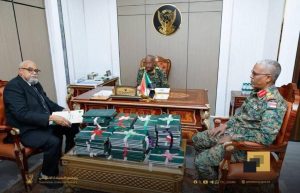
The image above shows the Auditor General, Salah El-Din Mohamed Osman, during his meeting with the Chairman of the Sovereign Council, Lieutenant General Abdel Fattah Al-Burhan, in Port Sudan on November 10, 2025. During that meeting, the audited financial reports of state institutions and government units were handed over to the Chairman of the Sovereign Council.
Since that date, there has been complete silence—no word about the report, nor about the Auditor General himself. Where has the Auditor General’s report gone? And why?
During the era of the former regime, the Auditor General’s reports were published openly, exposing corruption and violations, and were discussed publicly in parliament. Journalists would obtain rich material that fueled days of publication and wide-ranging debates. At the time, Ali Osman—may peace be upon him, wherever he is—insisted on publishing the report despite resistance from many within the government, who argued that its contents were “scandalous.”
Today, however, the report has been entirely absent since last year.
In recent days, leaks from the 2024 report have begun to surface, revealing boundless corruption and countless violations involving institutions, individuals, and companies.
Therefore, we say to the Auditor General:
You are legally obligated to publish the report in full. Attempts to conceal corruption within state companies and banks are futile. The report will inevitably come to light, and portions of it are already in our possession. It is better that you hold a press conference and present it to the public; otherwise, you will be regarded as complicit in covering up corruption.
We remind the Auditor General that Article 11 of the 2007 Auditor General Act explicitly requires the publication of the annual report within six months of its submission to the head of state. Any unjustified delay constitutes a clear legal violation and may expose those responsible to accountability.
This is not merely an ethical issue—it is also a legal one. The Auditor General is not an ordinary administrative employee but an independent oversight institution that is supposed to serve the people, not the executive authority. Withholding the report—if confirmed—raises direct questions:
- Has a legal duty been obstructed?
- Who has the authority to prevent the publication of a report funded by public resources?
Any unjustified delay in publishing audit reports can only be explained by one of two possibilities: either institutional incapacity or political pressure to suppress information. In both cases, the result is the same: opening the door to further corruption without deterrence.
2
Corruption of the Program… Not Just the Flour
The following statement issued recently by the Humanitarian Aid Commission in the Northern State caught my attention:
“The assigned committee has commenced its duties regarding the disposal of expired flour, amounting to 48,800 sacks stored in the warehouses of the World Food Programme.” Incidentally, this quantity is sufficient to feed approximately 20,000 to 22,000 average families for a full month (30 days).
The World Food Programme, which complains of funding shortages and its inability to deliver food to those in need, has thousands of sacks piled up in its warehouses until they spoil, while refugee camps from Darfur and elsewhere are located nearby.
The pressing question is: how do children and women die of hunger in displacement camps while tens of thousands of sacks of flour are discarded in garbage dumps?
What has occurred is not merely waste—it is a crime. The Humanitarian Aid Commission, the World Food Programme, and the Governor of Northern State must bear full responsibility before public opinion and the judiciary. The corruption lies not only in the flour but in the program itself.
3
More Missed Opportunities
It is well known that the food import bill in the Gulf countries exceeds $100 billion annually, according to multiple reports, including those by Mordor Intelligence. These countries import between 80% and 90% of their food from abroad and now face a growing threat—not just food shortages, but disruptions in supply chains.
Amid the current conflict, the Strait of Hormuz has become a chokepoint, constricting the flow of food just as it has constrained oil. Food has thus become a weapon of war, not merely a commodity. Shipping disruptions, rising insurance costs, and slower supply lines all threaten food security.
Food security in the Gulf is no longer tied solely to purchasing power, but to the ability to secure shipping routes, diversify supply channels, and build strategic reserves.
In this context, Sudan’s opportunity emerges strongly. Geography grants it an advantage that distant countries lack, and its resources provide substantial productive capacity. What is missing, however, is organizational capability and transformation.
In a previous article, I proposed that the Businessmen’s Union form an urgent committee to study Gulf market needs and immediately engage with major suppliers in the region, who are currently experiencing instability due to contractual obligations. If Sudan presents itself as a reliable alternative in this critical moment, it could achieve significant economic gains—and, more importantly, establish a lasting presence for Sudanese products in those markets.
This can be achieved through several pathways:
- Transitioning from seasonal sales to long-term contractual partnerships.
- Prioritizing animal feed production before final food products.
- Expanding exports of live, chilled, and processed meat in accordance with high health standards.
Most importantly, Sudan should position itself not merely as a farm, but as a logistical component of Gulf food security—by establishing collection and storage hubs near Port Sudan, securing agreements for refrigerated transport and storage, and developing shorter, faster shipping routes to Gulf and Red Sea ports.
In the current crisis, geography itself has become a commodity.
Source:Elaf