Ethiopia and the Blue Nile: Could the Sudanese Front Turn into a Regional Border War?
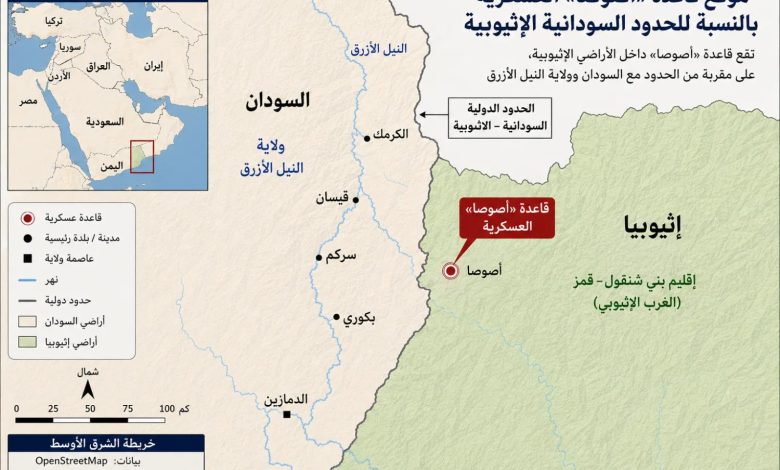
The most dangerous geographical development in Sudan’s war in recent weeks is not in Darfur, but in the Blue Nile.
The reason is straightforward: the fighting there is taking place directly alongside Ethiopia and South Sudan, while new Sudanese allegations center on the use of Ethiopian territory for training, logistical support, and drone operations.
Yesterday, the commissioner of Kurmuk raised the level of the allegations, saying that the Rapid Support Forces (RSF) are operating four camps inside Ethiopia to train fighters and mercenaries and to conduct activities linked to drones. On the same day, Abdel Fattah al-Burhan arrived in Damazin to inspect the front. (Sudan Tribune)
There is, so far, no independent public evidence that would allow all of the Sudanese official’s claims to be confirmed. This is a crucial point.
But the allegation has not emerged out of nowhere.
An analysis published yesterday by Critical Threats pointed to a sharp increase in flights linked to the United Arab Emirates to Ethiopia, as well as activity at a base in the Assosa area documented by open-source intelligence and satellite imagery. It also referred to previous reports by the Yale Humanitarian Research Lab regarding military and logistical mobilization in the area. (Critical Threats)
Geography explains why the issue is so sensitive.
Kurmuk and Qeisan lie on the edge of Ethiopia’s Benishangul-Gumuz region. Any force capable of operating freely on the Ethiopian side would gain strategic depth that Sudanese forces could not easily strike without risking turning the war into a confrontation between two states.
That is the difference between using a Sudanese border area and using the territory of a sovereign state.
If the Sudanese army determines that a drone was launched from Ethiopia to strike Damazin or Khartoum, military and political pressure would emerge to retaliate against the launch site itself, rather than merely intercepting the drone inside Sudan.
At that point, Article 51 of the United Nations Charter, along with the principles governing self-defense and state sovereignty, would become part of the military calculus.
But Ethiopia is not an easy adversary against which to open a new front without significant costs.
It has one of the largest population and military capacities in the Horn of Africa and maintains deep economic and political ties with Sudan, in addition to already sensitive issues involving Al-Fashaga, the Grand Ethiopian Renaissance Dam, the border, trade, and refugees.
For this reason, voices have reportedly emerged within the Sudanese authorities in recent months seeking to keep channels of communication open despite the allegations, according to regional reports.
The historical irony is also striking.
In 1997, Kurmuk and Qeisan were focal points of military operations by the Sudan People’s Liberation Movement and Sudanese opposition forces with regional support. Ethiopia was among the principal countries that provided territory and support to the opposition against the government in Khartoum at the time.
Nearly three decades later, the same area has returned to the forefront of the conflict.
But the parties have changed, and technology has changed dramatically. In 1997, geography required thousands of troops to exert influence. In 2026, a single drone platform can make a base hundreds of kilometers away relevant to the course of the war.
The most dangerous scenario is this: if offensive operations launched from Ethiopian territory are confirmed and continue, the question could shift from “Is Ethiopia supporting the Rapid Support Forces?” to “Will Sudan strike targets inside Ethiopia?”
At that point, Sudan’s war will have crossed a new threshold.